
History of the Christmas Hamper in Spain
From post-war Christmas bonuses to the gift box each employee chooses online: how a nougat and a bottle of aniseed became Spain's most enduring corporate tradition.
Published on July 30, 2026
The Origin: The Christmas Bonus
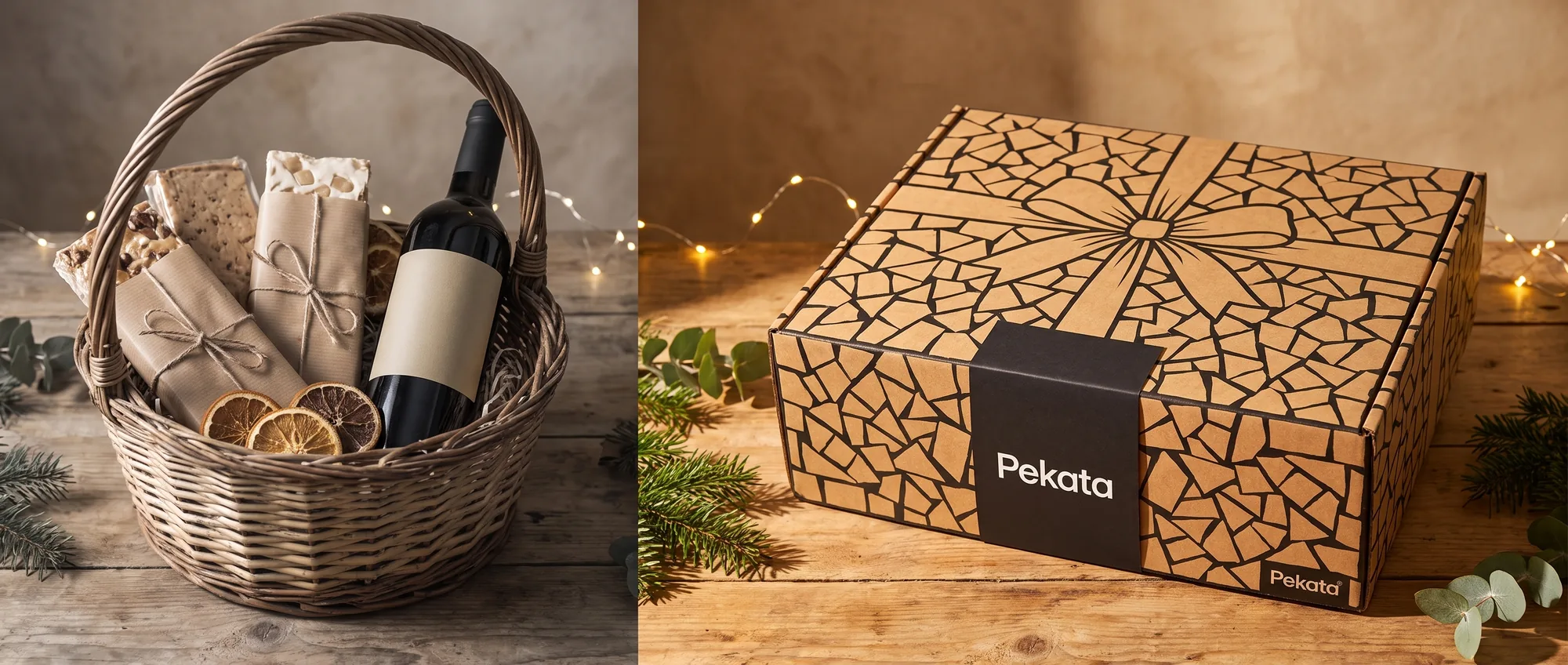
The Spanish Christmas hamper originates from the 'aguinaldo', a bonus given by employers and lords to workers and servants at Christmas. For centuries, it was food: what might be lacking at home in December. The hamper as an object — wicker, cellophane paper, ribbon — became popular in mid-twentieth century Spain, when industrial companies began distributing it systematically among their staff.
Its composition was soon established and has barely changed: nougat, marzipan, polvorones, a bottle of wine or cava, some liqueur, preserves and cured meats. A menu that depicted the possible abundance of the time and, interestingly, remains the mental standard of a 'Christmas hamper' eighty years later.
From Custom to Right
Over the years, the hamper ceased to be a voluntary gesture and became something more serious. As it was repeated unconditionally year after year, Spanish courts began to consider it a more beneficial condition: an acquired right that the company cannot unilaterally remove. There have been rulings that required its reinstatement after withdrawal.
In parallel, Hacienda (the Spanish tax authority) established its criteria: the hamper is a benefit in kind and must be valued in the payroll. Thus, a gesture born of informal generosity ended up with its own labour and tax record — a good summary of Spain's twentieth-century economic history.
The Recent Shift: From Hamper to Catalogue
The crises of 2008 and 2020 tightened budgets and highlighted an uncomfortable truth: much of the hamper's contents went unused. At the same time, workforces became more diverse — diets, beliefs, single-person households, remote work — and the identical box for everyone began to feel outdated.
Hence the current model: the company maintains the gesture and the budget, but the recipient chooses the contents, and the box is delivered to their home, wherever that may be. The tradition survives; what changes is who decides what's inside. Like in 1950, it's still food and a gesture in December — only now no one has to pretend they like aniseed.
Frequently asked questions
Since when have Christmas hampers been given in Spain?
The custom descends from the 'aguinaldo', of very ancient origin, but the corporate hamper as we know it became widespread in the mid-twentieth century with industrialisation and the expansion of salaried employment.
Why do they always include nougat, cava, and polvorones?
Because the composition was established when the hamper represented the possible abundance of the time: Christmas sweets, something to drink, and long-lasting preserves. The format was inherited almost intact.
Does the Christmas hamper still make sense today?
The gesture does: it's one of the few collective recognitions that remain. What no longer makes sense is that a single box has to please the entire workforce.